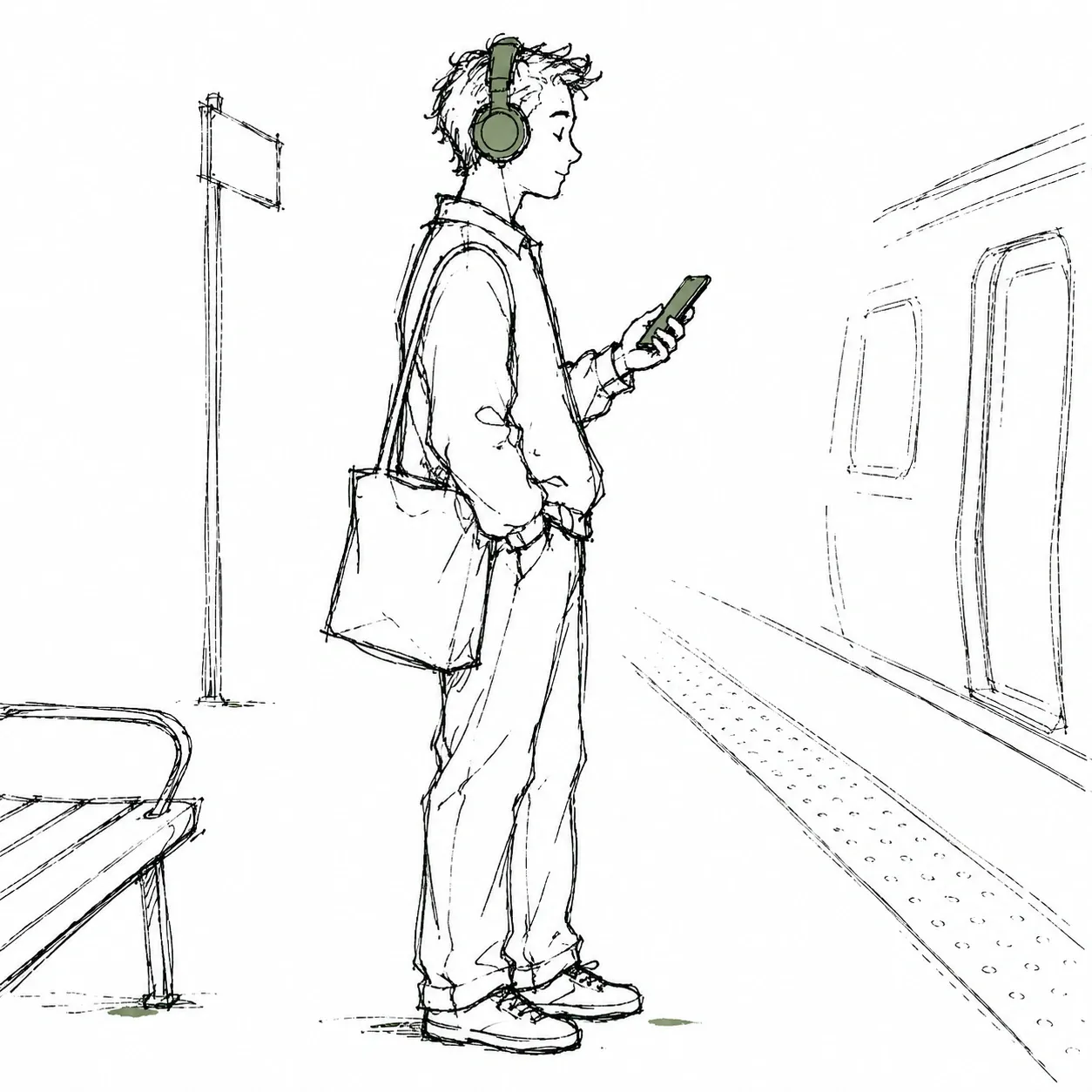
It feels like all the learning and memorization tools are made for visual learners. Flash cards, videos, diagrams.
And if you're an auditory learner, you're expected to adapt.
But there's neuroscience behind how aural learning works that suggests that for certain kinds of content, it might be the better option.
Why Learning Tools Focus on Visual Learners
Picture this:
(I'm kidding. That part was for the visual learners.)
But you get the point: visual is everywhere.
Research consistently reveals the "visual dominance effect" which is the fact that many times visual processing outperforms auditory processing. A 2025 neuroimaging study found that, especially when mental load is high, visual working memory is more likely than aural to hold up.
So there's a reason why flashcard apps, educational videos, and infographics dominate. They're playing to one of the brain's natural strengths.
But in fact, the auditory system does have its own advantages. When you learn by listening, you're using a completely different set of neural pathways that excel at different tasks.
The Neuroscience Behind Learning by Listening
Two Separate Memory Systems
Your brain doesn't just process a single channel. It has what psychologist Alan Baddeley calls the "working memory model" which is basically two semi-independent systems running at the same time:
- The phonological loop (which handles sounds and words you hear)
- The visuospatial sketchpad (which handles images and spatial layouts)
And your memory can handle auditory and visual material in parallel without the two systems interfering much with each other. This is called dual-channel processing, and it's why combining what you hear with what you see often creates the strongest memories.
Sequential Processing
Your auditory system has a brief sensory memory called echoic memory. A mental "replay button" that lasts a few seconds and allows you to hold onto sounds just long enough to process them.
Visual memory has something similar called iconic memory, but it's much more brief. Just fractions of a second.
This means that for sequential, ordered information like speeches, scripture verses, or procedural steps, the auditory modality has the edge.
Memory research with children found that when tasks were made sequential for both modalities, auditory memory often came out superior to visual.
This is why content meant to be spoken (speeches, scripts, verses you'll recite) should ideally be learned through listening. As you do that, you're memorizing the words and also encoding the natural rhythm and flow that makes oral delivery smooth.
Hearing Your Own Voice
In 2010, researcher Colin MacLeod and his team published what they called the production effect. Their research showed that reading words aloud improves explicit memory by 10–20% compared to reading them silently.
The mechanism is this: when you produce words aloud you're creating what the researchers call "distinctive encoding." While you're processing the meaning of the words, you're also encoding the motor act of speaking them and the sensory experience of hearing your own voice. This creates additional retrieval pathways that silent reading doesn't provide.
How to Learn (and Memorize) by Listening
The Problem with Passive Listening
Maybe the reason for preferring visual learning is because we're doing aural learning wrong.
Passive listening creates familiarity. You get exposure to new ideas and stay informed. But you're only creating familiarity, not memorization.
Saying the words yourself, testing yourself out loud, engaging with the material through your own voice, creates the kind of deep memory you can access on demand.
The reason is the difference in engagement. When you're passively listening, perhaps while driving or doing dishes, you're processing the content but not necessarily storing it.
Spaced Repetition + Active Recall
In 2019, researchers at Beijing Normal University used EEG to study what happens in the brain during spaced learning (reviewing material at increasing intervals) versus massed learning (cramming everything at once). They found that spaced learning improves long-term memory by building stronger, more consistent representations of the material.
And spacing works best when it's combined with active recall. Each time you encounter the material again, instead of passively listening or reading, you're actively trying to remember it. This creates what researchers call "desirable difficulty."
This is the principle behind the Pimsleur language learning method, which has been remarkably effective for decades. Pimsleur combines spaced repetition with active recall in an audio format. You hear a phrase, you're prompted to say it back, and this phrase returns at increasing intervals. The same neuroscience that makes Pimsleur so effective for learning languages can also be applied to memorizing text.
Hear, recall, then encounter it again after a gradually increasing interval. This fits with how memory consolidates, first in working memory, then into long-term storage.
Audio + Movement
Audio also pairs with something no visual method can: movement.
Your morning commute, your daily walk, your time at the gym happen to be more than "brainless" activities when you can focus on learning. The combination of auditory input and physical movement actually creates stronger memory encoding than sitting still at a desk.
Several factors could be responsible for enhancing this. Maybe it's increased blood flow, or maybe it's the multi-sensory nature of the experience. Whatever the mechanism, it's clear that learning while moving works.
This also happens to make audio learning fit well into modern life. Instead of cramming more study time into an already slammed schedule, you're repurposing parts of your schedule for learning opportunities. Hands-free and screen-free.
Internalization vs Memorization
There's a difference between memorizing something and internalizing it. Memorization gets you accurate recall. Internalization gets you something deeper. Content that shapes how you think, that shows up naturally in your conversations, that influences your decisions without conscious effort.
When you learn by listening using spaced repetition and active recall, you're creating the conditions for this deeper kind of encoding.
- The repetition builds familiarity.
- The active recall forces retrieval from memory rather than mere recognition.
- The auditory modality adds the dimension of sound and rhythm that helps content stick.
This is internalization, and it's the goal especially when you're memorizing content that matters to you. It could be Scripture you want to live by, speeches you want to deliver with confidence, or knowledge you want to genuinely own rather than temporarily rent.
When to Choose Aural vs Visual Learning
For all the benefits of aural learning, there are certain scenarios where it's the undisputed choice and others where you might choose a different method.
It's ideal for:
Scripture or meaningful text you want to deeply internalize. Sequential content with a lot of meaning that you want to not just memorize but really own. This is where the combination of audio, spaced repetition, and movement creates profound results.
Language learning. Pronunciation, conversational patterns, listening comprehension. You simply must hear these things to learn them effectively. The auditory modality isn't optional here; it's essential.
Speeches and scripts. Anything you'll eventually deliver out loud benefits from being learned through listening and speaking. You're encoding not just the words but the rhythm, pacing, and flow that makes oral delivery natural.
Procedural knowledge and sequential content. Step-by-step instructions, ordered lists, anything where sequence matters. The auditory system's strength in handling temporal information gives it an edge.
When you should combine modalities or stick to visual:
Some content demands to be seen. Maps, diagrams, complex visual relationships, mathematical equations simply need your eyes. The key is knowing when audio is the primary channel versus when it's just a supporting player.
Note: this audio-first approach is specifically for auditory learners. If you consistently learn best by seeing and visualizing, you might want to expand your habits by trying aural learning, but forcing yourself into a different method might not be effective. That's perfectly okay. Know yourself, and choose methods that align with your strengths.
Making Aural Learning Work in Your Life
The biggest reason to learn by listening is because it fits the most easily of any method into your busy life.
Commuting, walking, exercising are likely one of the only places in our schedules that could be used to learn. Bonus points for doing while moving because that helps it stick.
And since we're more likely to continue a habit if we attach it to something we already do, aural learning also sticks to the calendar better.